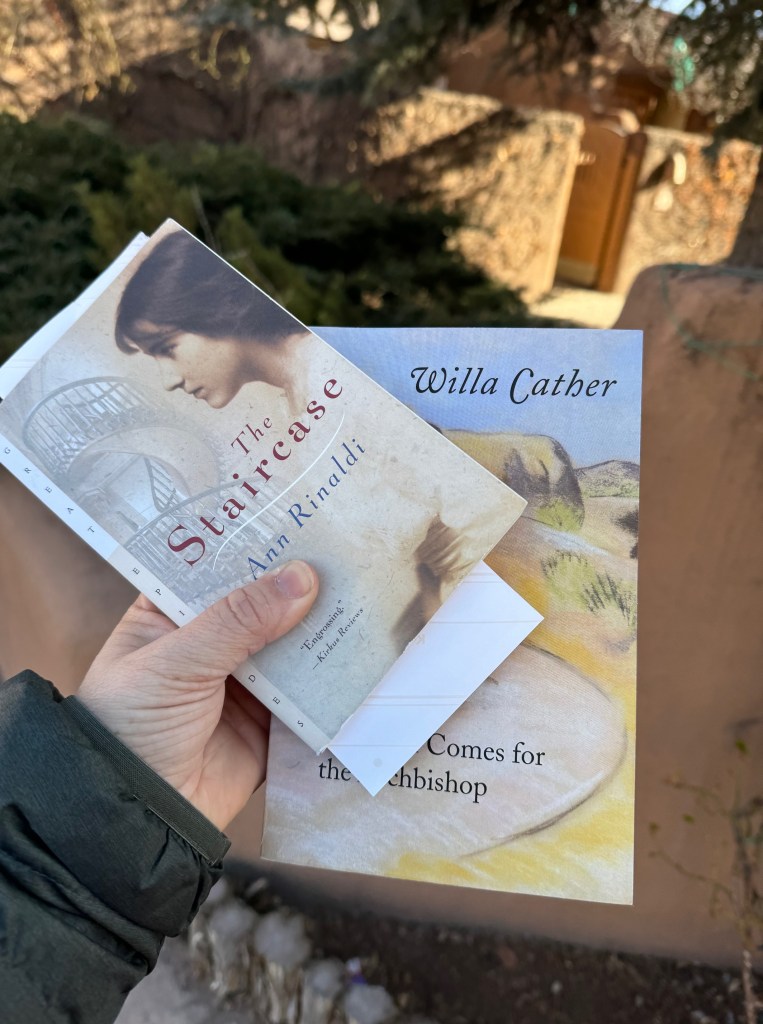
When we visited Santa Fe last spring, it was not only a dream trip for my mom, but a literary pilgrimage for me. When we were planning our stay and our adventures, I was thrilled to find that there were two churches that figured in two books I have read— and I was excited to see them. And not only was I able to visit The Cathedral Basilica of St. Francis of Assisi (which appears in Willa Cather’s novel “Death Comes for the Archbishop”,) I was also able to visit The Loretto Chapel with it’s famous staircase which is featured in the Ann Rinaldi Young Adult book called, well, “The Staircase.”
And as Santa Fe is definitely a city where ‘more is more’, right around the corner from these two amazing holy spaces was The San Miguel Chapel.…the oldest church in the United States. You know that was right up my alley! And lucky for me, my mom and my daughter were nice enough to humor me and toured all these beautiful places with me! Come along, wont ya?
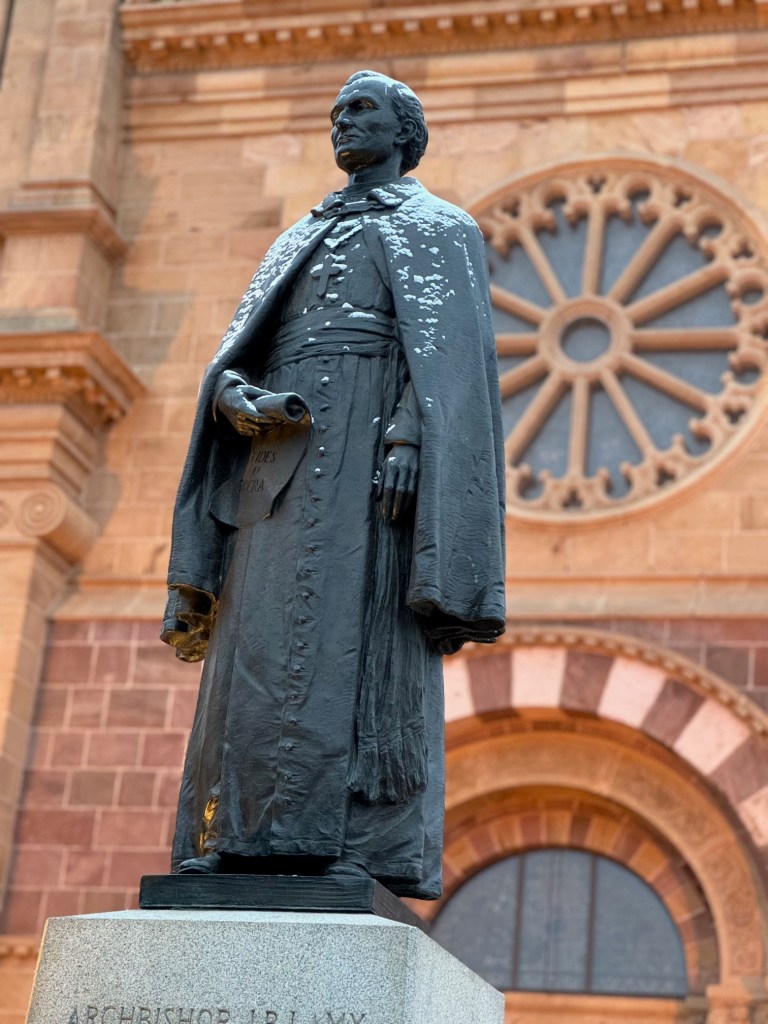
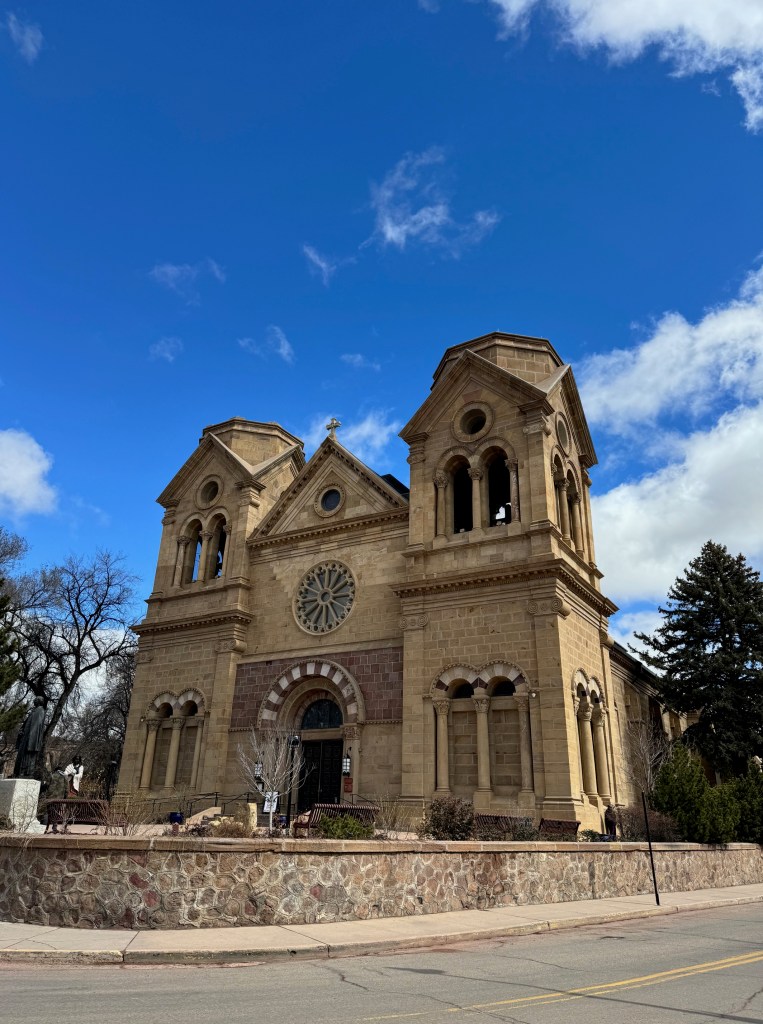
In the midst of Santa Fe’s Old Town, the St. Francis of Assisi Cathedral Basilica reigns. Outside, there is a beautiful statue of Archbishop Lamy, the inspiration for Bishop LaTour in Cather’s classic novel “Death Comes for the Archbishop.” He was a French priest who traveled to the desert Southwest to become the area’s first bishop and became a bit of a legend in his own time.
I love this novel because it tells such rich stories about our nation’s early days in a way we are not used to hearing- which is very Anglo-centric. However, indigenous people have lived in the southwest for centuries, and Spanish settlement began in the area in the 16th century, well before anyone landed in Plymouth (or Roanoke, for that matter!) I thoroughly enjoyed learning about the history of Santa Fe through Cather’s books and then later Santa Fe and New Mexico historians like New Mexico State Historian Rob Martinez and his YouTube Channel.
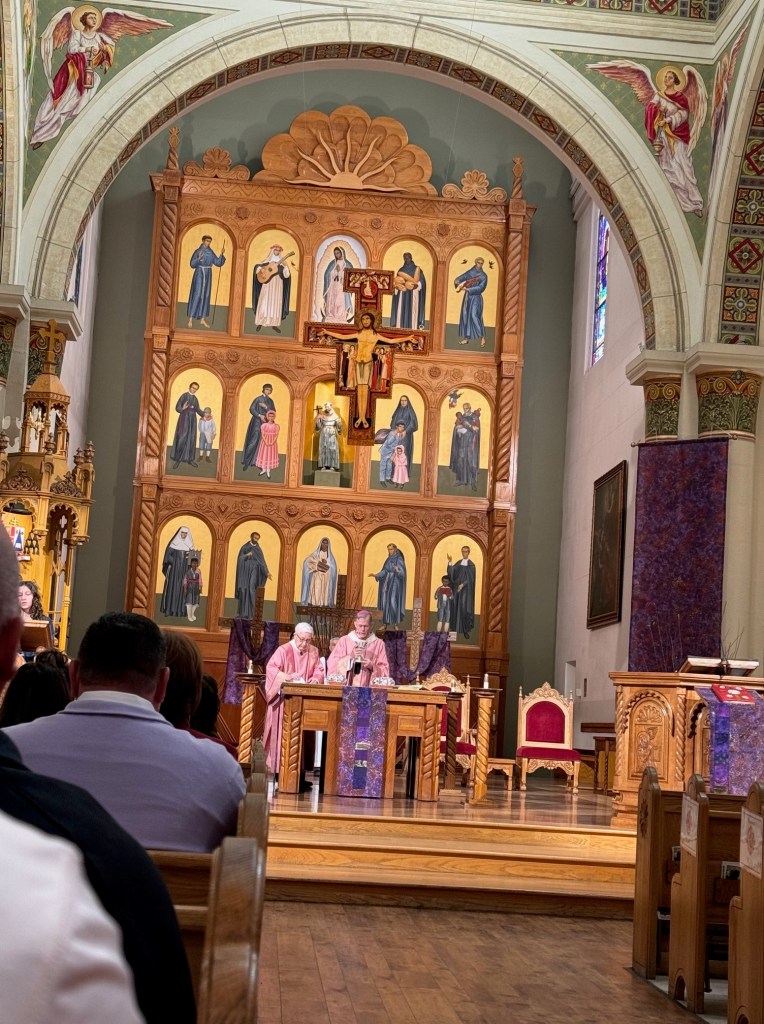
We were able to attend Mass at the Cathedral and it was beautiful. The side chapel was perhaps my favorite part, as it contains the centuries old wooden beams of the church that stood on these same grounds before the grand cathedral was built. Here are some photos from inside this gorgeous, historical building:
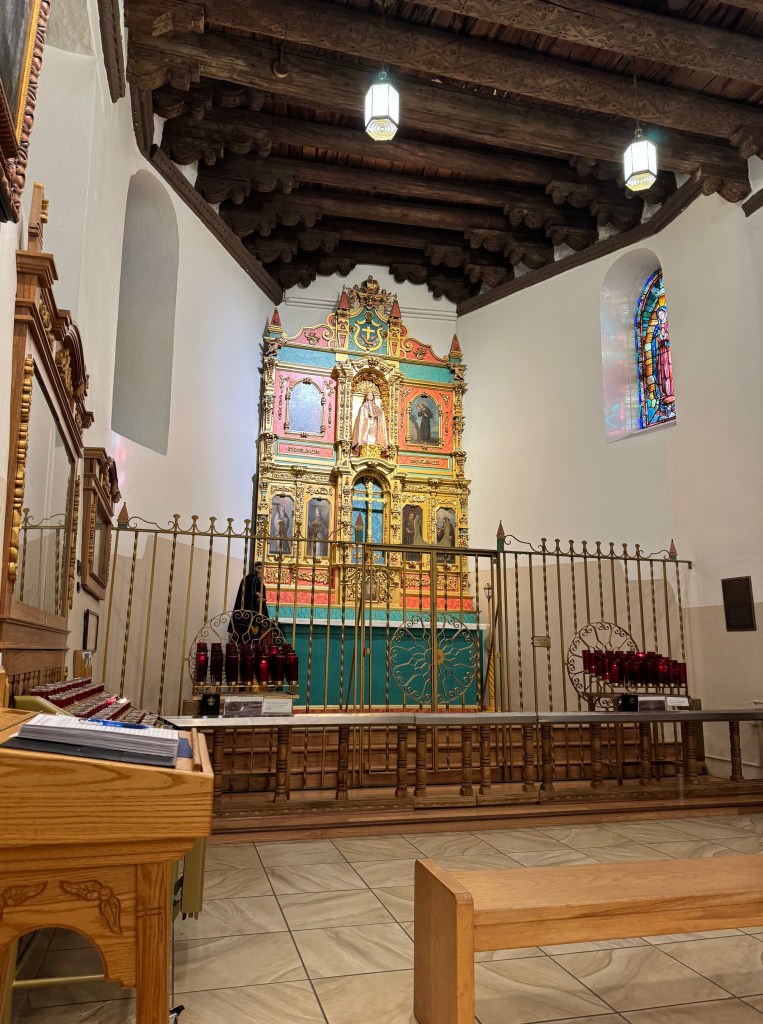
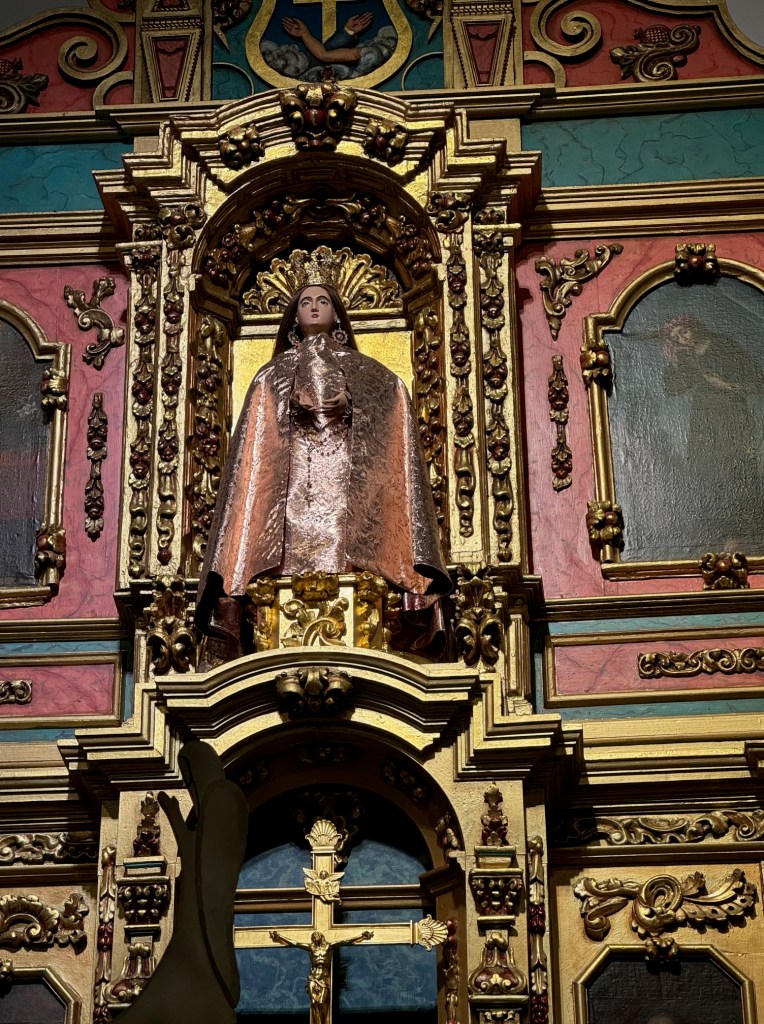
Above you will see “La Conquistadora”, or “Our Lady of Peace”, also known as America’s Oldest Madonna, dating back to the early 1600s. She is displayed in a place of honor in the altar of the side chapel, which contains the elements of the older church. Her origin is Spanish, and date of creation unknown, but records show that she was brought to the city of Santa Fe in church records by at least 1626. The city now honors her at Fiesta de Santa Fe each August, and there is a Novena in her honor in the month of June.

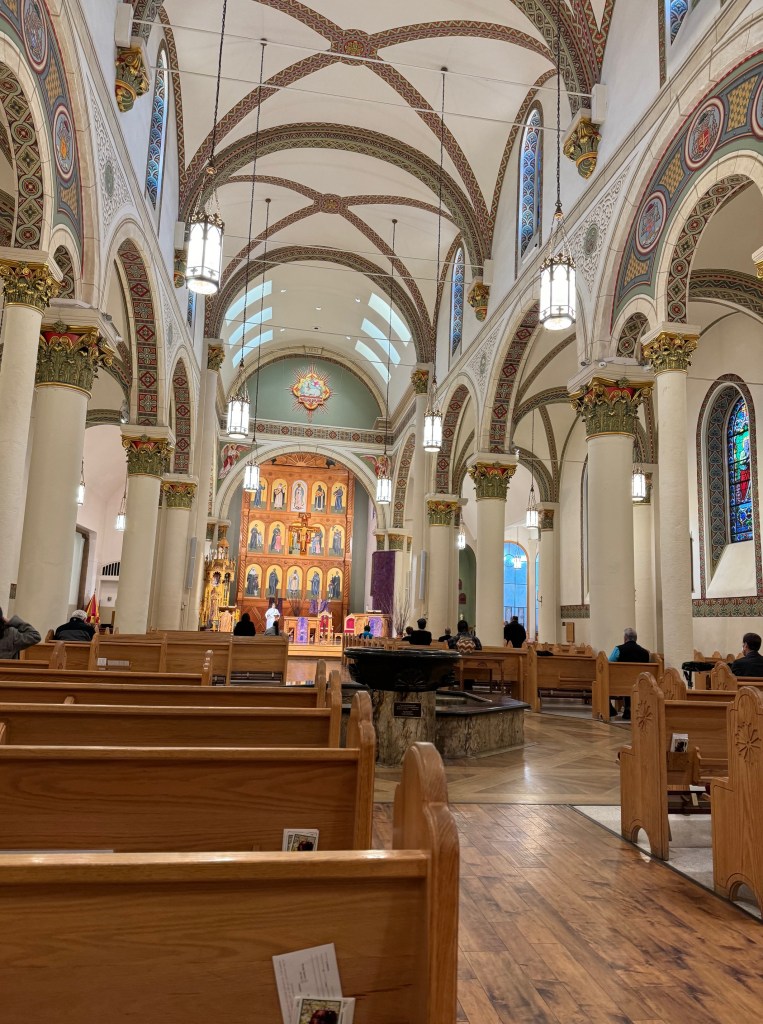
And while the Cathedral may preside over the city like a Romanesque queen, there are other beautiful sacred spaces just around the corner (quite literally!) , including the small gothic style chapel I was so excited to see- The Loretto Chapel.
The Loretto Chapel was built for the Sisters of Loretto in the 1870s. At the invitation of Bishop Lamy, The Sisters of Loretto ran a girls’ school in the city after New Mexico became an American territory. Many of the city’s more affluent citizens sent their daughters to this school, and it was the beginning of formal education for girls in the area.
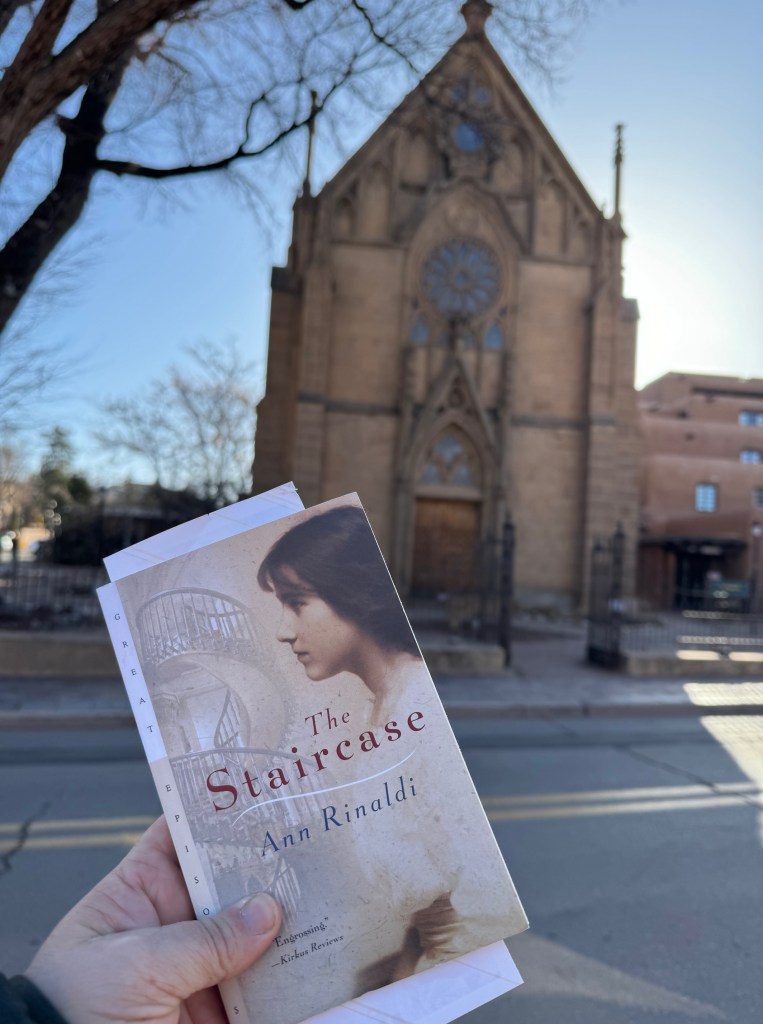
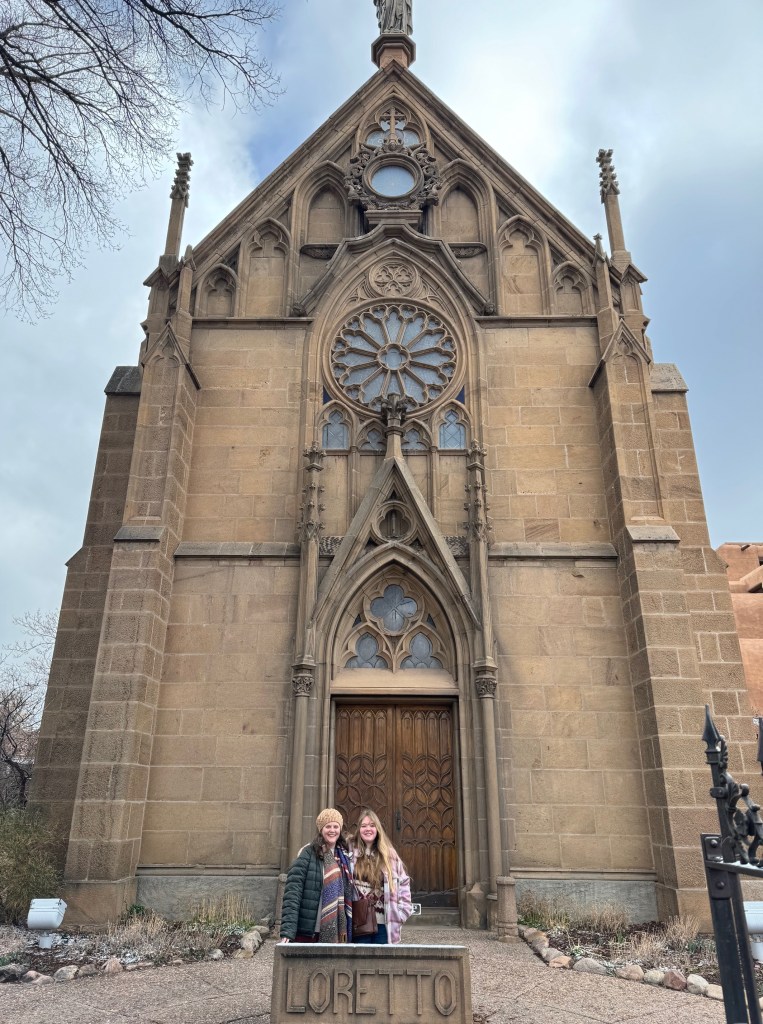
According to the chapel’s website, “Our Story begins in 1850 when the Vicariate of New Mexico was established under the first Bishop of the Territory, Bishop Jean Baptiste Lamy. Seeing a need to educate the girls of the Territory, Bishop Lamy sent a plea to Catholic teaching orders to open a school for girls. The Sisters of Loretto responded and sent six sisters to open the Loretto Academy. Having been recently under Mexican rule, the Territory of New Mexico was full of Spanish-speaking citizens, so the six had to learn the Spanish language and, after an arduous trip during which the Mother Superior died, finally arrived in Santa Fe and opened their school in 1853.
“By 1873, the Sisters were able to start the construction of a Chapel. Using the same French architect and builders as Saint Francis Cathedral Basilica, the Chapel of Our Lady of Light (as it was then known) was patterned after Archbishop Lamy’s favorite Sainte Chapelle in Paris. With its gothic-style architecture, the Chapel certainly would have stood out among the small adobe homes surrounding it at the time.
Unfortunately, the architect died before access to the choir loft was built. Given the height of the loft and the small size of the Chapel, a staircase would have taken up too much floor space, thereby reducing the seating capacity to an unacceptably small level. Legend states that seeking guidance and help, the Sisters of Loretto prayed a nine day novena to St. Joseph, Patron Saint of Carpenters. A novena is a special prayer said for nine consecutive days. On the final day of the novena, a carpenter appeared with only a hammer and carpenter’s square. He built what is now known as the Miraculous Staircase with simple tools and wooden pegs. The rare wood is not native to the American Southwest. When the Staircase was complete, it is said that the carpenter disappeared without receiving thanks or payment. The Sisters tried all local lumber stores but could not find accounts open for supplies for their stairs. Some believe the carpenter was St. Joseph himself while others believe that is was someone sent by St. Joseph. What is known is that the Sisters of Loretto prayed, and their prayers were answered.“
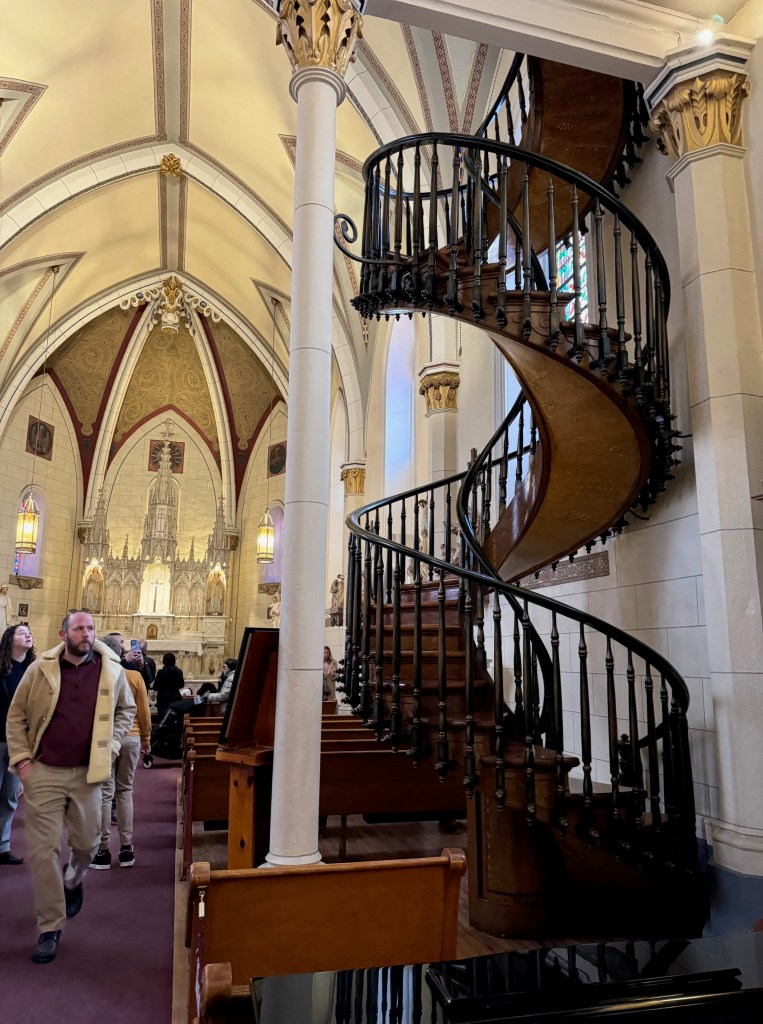

The story of the mysterious man who built the exquisite staircase has now become local legend. Many stories and theories about who the staircase builder really was grew over the decades, and while the girls’ school no longer exists and the chapel is no longer a property of the Catholic diocese, people still flock to the chapel to see the amazing staircase and ponder its unique beauty.
This video gives some more information and views of the staircase and chapel, if you’d like to see it. Also– the Loretto Chapel has perhaps the best giftshop in the city!
And finally- we were able to visit the beautiful and very old San Miguel Chapel. Possibly the oldest church in the continental United States, the adobe church was built by Native Mexican Indians under the guidance of Franciscan missionaries. The Franciscans were some of the first missionaries to the area, and so St. Francis is the Patron Saint of Santa Fe. In fact, Santa Fe is an abbreviation of “Villa Real de la Santa Fé de San Francisco de Asis“, which when translated into English is “The Royal City of the Holy Faith of St. Francis of Assisi.” A bit of a mouthful! So, Santa Fe it is! 😉

This church is so SO beautiful. It was built between the years of 1610 and 1625 and has stood as a place of worship under the flags of Spain, Mexico and now The United States. Inside, there is a beautiful Altar piece that was given to the chapel in the 18th century and features a statue of St Michael the Archangel (San Miguel) in a silver helmet. He once held scales of justice, which are now missing. Other saints featured on the altar screen include St. Francis, St. Teresa of Avila, St. Louis of France, St Gertrude and St. Clare of Assisi.
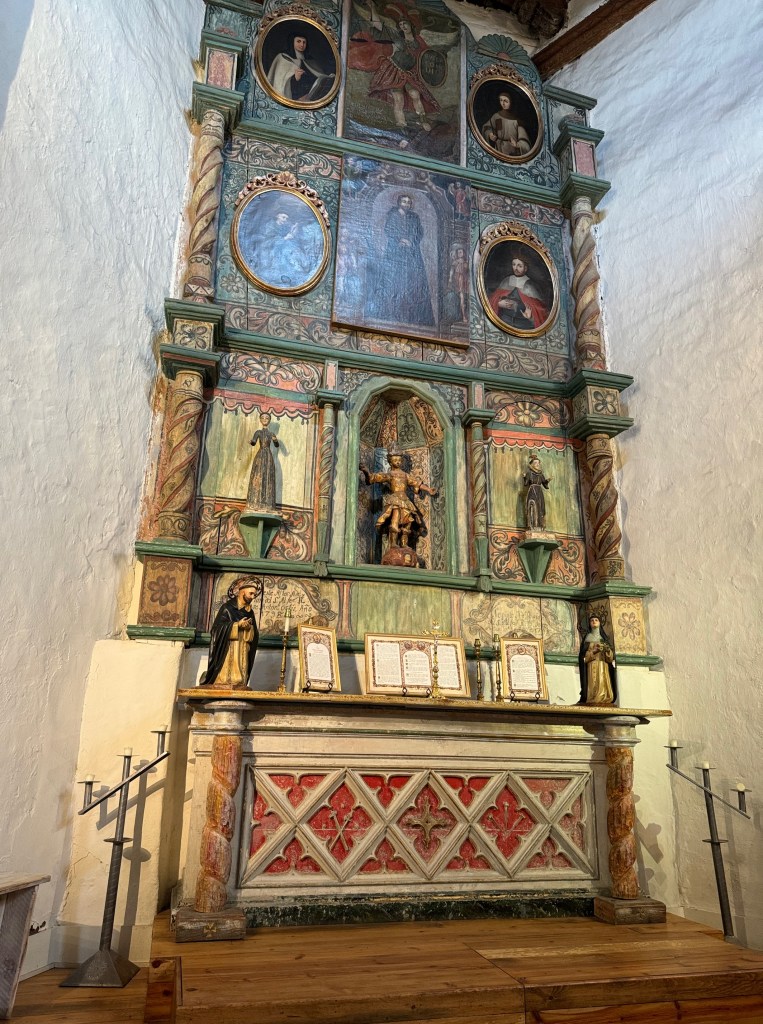

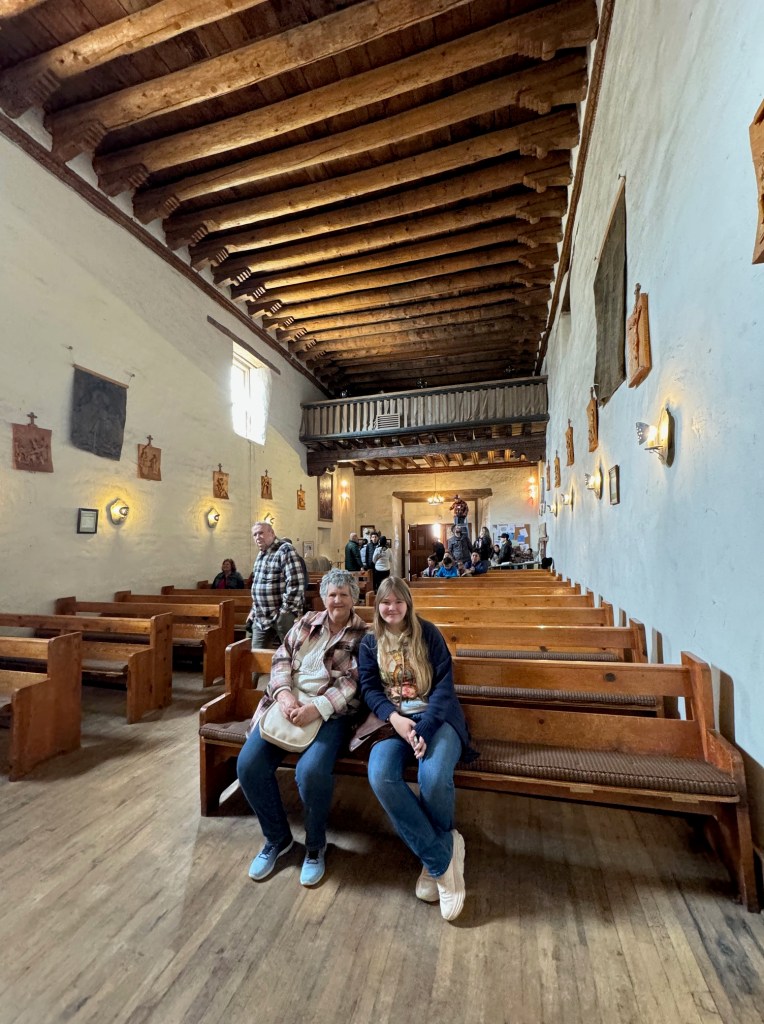
We were able to take a tour of the chapel with a wonderful guide, and we took our time to look at the old carved beams, centuries old tapestry wall hanging, and an intriguing bell covered in miligros (little silver charms that symbolize prayers, hopes or things to be thankful for).
The bell has it’s own interesting legend, which says it was cast in Spain in the 14th century. According to the website, “The legend of the first church bell goes back to Spain and its eight-century-long battle with the Moors. In the small hamlet of San Jose in Andalucia, the villagers prayed to St. Joseph for protection. They promised that if they were saved from the Moors they would honor him. With their prayers answered, a bell was cast as a tribute of appreciation. Through their unrelenting faith and prayers, they believed that each time the bell rang, the power of the Moors declined. Therefore, the Christians had gained victory each time the bell rang triumphantly. With the prayers of the people answered their enemy was finally expelled from Spain.
“The legend goes on to say that during the 17th century, the bell was brought to Santa Fe by ship from southern Spain. It was transported by wagon up the Camino Real by Nicolas Ortiz Niño Ladron de Guevara. The bell was placed in a capilla (small chapel) he built for his family. After the Pueblo Revolt it was placed at San Miguel Chapel. In 1872 the bell was damaged by a storm and removed to the interior of the church for protection and preservation where it resides today.”
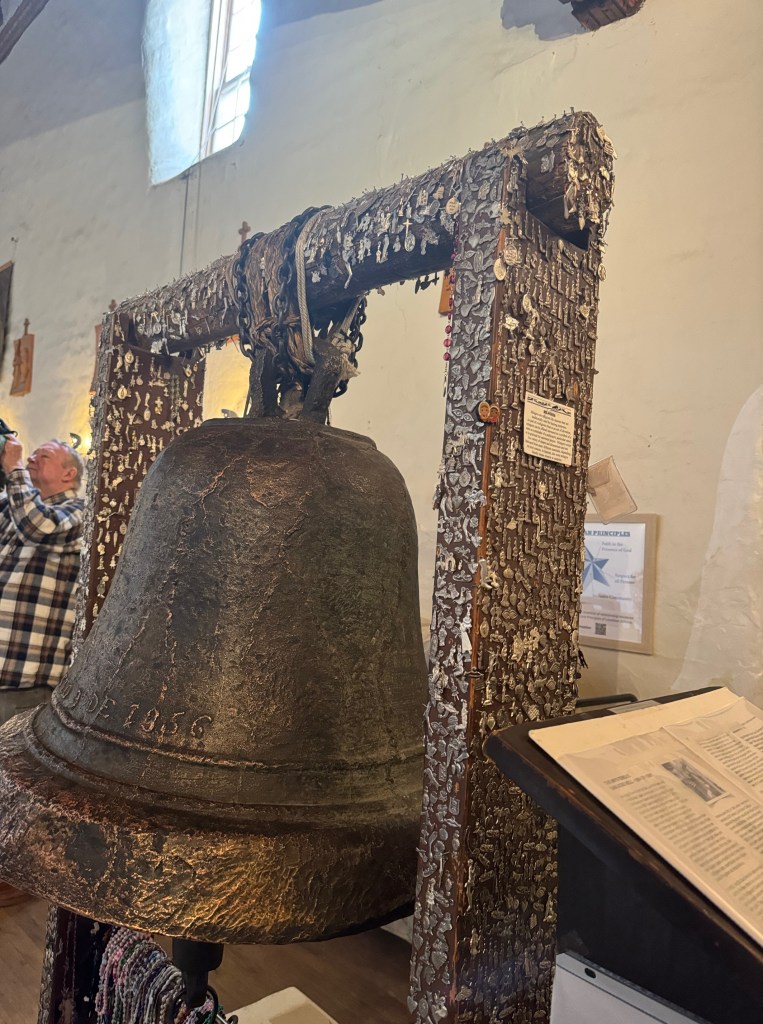
While this story is amazing, historians have questioned its truthfulness because the date cast onto the bell is written in the way Americans write (month/date/year) and NOT how it would have been written in Europe (day/month/year.) Either way, the bell is beautiful and has such a warm, lovely tone (visitors are allowed to ring it!) and all the little miligros, which symbolizes prayers and petitions of hundreds of people, is moving to see.
If you’d like to learn more about the San Miguel Chapel, this is a nice video to watch:
And so, these are some of the amazing places to see in Santa Fe! I hope you enjoyed this little tour of these beautiful holy places. I know it will always be in my heart, and inspiring for my art!
Til next time,
Take Joy-H




 Sleightholm Folk Art
Leave a comment